Manufacturing is entering 2026 under a different set of pressures than the industry faced only a few years ago. Energy volatility, geopolitical uncertainty, tighter environmental rules, persistent labour shortages and faster technology cycles are reshaping investment decisions across factories and supply chains.
The central question is no longer whether manufacturers should modernise. It is how quickly they can do so while protecting margins, maintaining operational resilience and proving measurable progress on sustainability. Digital tools remain important, but technology alone will not define the next phase of industrial competitiveness. The winners will be companies that connect data, people, energy and capital into a more adaptive operating model.
Several manufacturing trends are likely to have an especially strong influence in 2026, from artificial intelligence and industrial robotics to nearshoring, circular production and low-carbon energy systems.
Artificial intelligence moves from pilot projects to factory operations
Artificial intelligence has been a prominent topic in manufacturing for several years. In 2026, the focus is expected to shift from experimentation to deployment at scale.
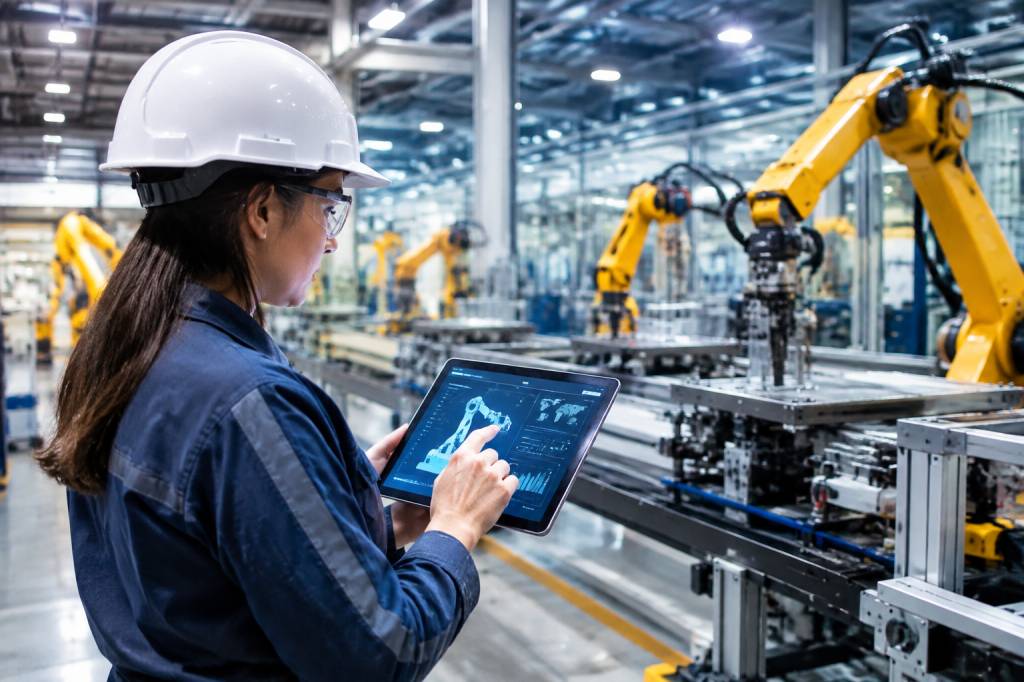
Manufacturers are already using machine learning for predictive maintenance, quality inspection, production scheduling and demand forecasting. The next step is the integration of these applications into broader industrial systems, allowing AI to support decisions across the plant rather than solving isolated problems.
For example, an AI-enabled production platform can combine machine data, maintenance records, energy consumption and order forecasts. Instead of simply warning that a motor may fail, the system can recommend the best maintenance window based on production demand, spare-parts availability and the cost of stopping the line.
This distinction matters. A predictive alert is useful; an operational recommendation that fits the wider business context is considerably more valuable.
Generative AI will also become more visible on the factory floor. Engineers may use natural-language interfaces to search technical documentation, troubleshoot equipment or generate maintenance instructions. Operators could receive step-by-step guidance through mobile devices or augmented-reality glasses, reducing the time needed to diagnose unfamiliar problems.
However, adoption will depend on data quality and governance. Many manufacturers still operate with fragmented systems, inconsistent machine standards and incomplete historical records. AI cannot compensate for unreliable data indefinitely. In 2026, investment in data architecture, cybersecurity and workforce training will be just as important as investment in algorithms.
Autonomous and collaborative robotics expand their role
Robotics will continue to reshape manufacturing, but the most significant growth may come from flexible systems rather than traditional fixed automation.
Collaborative robots, or cobots, can work alongside employees on tasks such as assembly, packaging, machine tending and inspection. Their relatively compact footprint and simpler deployment make them attractive to small and mid-sized manufacturers that cannot justify a fully automated production line.
Mobile robots are also becoming more capable. Autonomous mobile robots can transport components, finished goods and tools through facilities without requiring fixed conveyor systems. When connected to warehouse-management and manufacturing-execution software, they can dynamically adjust routes as production priorities change.
This flexibility is increasingly important as customers demand more product variants and shorter delivery times. A factory built around a single high-volume product may be efficient, but it can struggle when demand becomes less predictable. Flexible automation allows manufacturers to respond without rebuilding the entire facility.
The shift will not eliminate the need for human workers. Instead, it is likely to change the nature of their roles. Employees will increasingly supervise automated systems, manage exceptions, perform higher-value technical tasks and contribute to continuous improvement.
The key challenge is integration. Robots that operate in isolation may improve one process while creating bottlenecks elsewhere. The strongest results will come from connected automation strategies that link production, logistics and quality management.
Digital twins become practical decision-making tools
Digital twins have often been presented as a sophisticated technology reserved for large corporations. By 2026, their use is expected to become more practical and targeted.
A digital twin is a virtual representation of a physical asset, process or facility that is continuously updated with operational data. It can be used to test production changes, simulate maintenance scenarios or assess the likely impact of new equipment before physical installation.
Consider a manufacturer planning to increase output on an existing line. A digital twin can help evaluate whether the constraint is machine capacity, material flow, labour availability or energy supply. It can also model the effect of running equipment at higher speed, including potential impacts on quality and maintenance.
The technology is particularly useful for commissioning new facilities. Engineers can test production sequences, operator workflows and safety procedures before the plant becomes operational. This can reduce costly delays during start-up, when small design problems often become expensive operational issues.
Digital twins will also support decarbonisation strategies. Companies can model the effect of electrifying process heat, installing on-site generation, changing production schedules or increasing recycled material content. In this context, the digital twin becomes more than an engineering tool: it becomes a bridge between operational planning and environmental performance.
Energy management becomes a competitive capability
Energy is no longer simply a utility cost to be monitored by the finance department. For energy-intensive manufacturers, it is becoming a strategic production variable.
Electricity prices, grid constraints, renewable-energy targets and carbon reporting requirements are pushing companies to examine when and how energy is consumed. In 2026, more manufacturers are expected to combine smart meters, industrial energy-management software, battery storage and on-site renewable generation.
One practical development will be the optimisation of production around energy availability. A factory with flexible processes may be able to run certain operations when electricity is cheaper or when renewable power is more abundant. This approach requires careful coordination: energy savings cannot come at the expense of delivery performance or product quality.
Industrial heat will remain one of the most difficult challenges. Electrification, heat pumps, thermal storage, hydrogen and low-carbon fuels may all play a role, depending on the process and regional infrastructure. There will be no single solution for every sector. Steel, chemicals, food processing and cement have fundamentally different energy profiles.
Manufacturers should therefore avoid treating decarbonisation as a collection of disconnected projects. The more effective approach is to build an energy roadmap that connects equipment investment, production planning, procurement and long-term capital strategy.
Supply chains move from lean to resilient
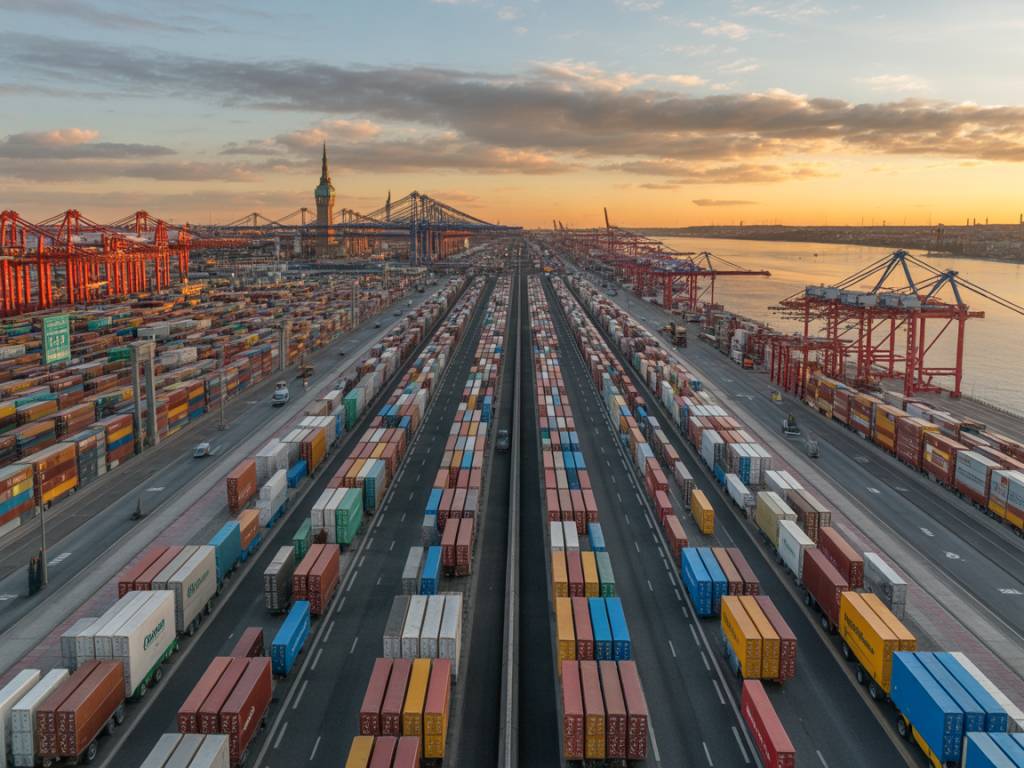
The supply-chain disruptions of recent years have challenged the assumption that maximum efficiency should always be the primary objective. In 2026, manufacturers are likely to place greater value on resilience, visibility and optionality.
Nearshoring and regional production will remain important themes, particularly for strategic components, electronics, pharmaceuticals and energy technologies. Companies are not necessarily abandoning global supply chains, but they are reassessing where critical dependencies exist.
A resilient supply chain may involve multiple suppliers, regional warehouses, alternative materials and more transparent data sharing. It may also require a willingness to hold additional inventory for components that could stop an entire production line.
Artificial intelligence will support this transition by improving demand sensing and identifying early signals of disruption. Yet technology cannot replace supplier relationships. Manufacturers need robust qualification processes, clear communication and a realistic understanding of suppliers’ own capacity constraints.
The most advanced companies will map their supply chains beyond tier-one suppliers. A shortage at a second- or third-tier producer can be just as damaging as a problem with a direct supplier, particularly when the component is specialised and difficult to replace.
Industrial cybersecurity becomes a board-level issue
As factories become more connected, the potential impact of cyberattacks grows. Operational technology, industrial control systems, robotics and enterprise software are increasingly linked, creating new points of vulnerability.
In 2026, cybersecurity will be treated less as an IT project and more as a core element of operational continuity. A successful attack on a manufacturing site can interrupt production, compromise intellectual property, delay deliveries and create safety risks.
Manufacturers will need to strengthen several areas:
- Asset inventories covering both information technology and operational technology.
- Network segmentation to limit the spread of an intrusion.
- Multi-factor authentication and stronger access controls for employees and suppliers.
- Continuous monitoring of connected equipment and remote-access activity.
- Incident-response plans that include plant managers, engineers and senior leadership.
- Regular training that reflects the realities of factory operations.
Cybersecurity is often discussed in technical language, but the business question is straightforward: how long can the plant operate if a critical system becomes unavailable? Manufacturers that can answer this question clearly will be better prepared to protect both revenue and customer trust.
Skills, not just machines, will determine productivity
Technology investment will not deliver its full value without the people capable of using, maintaining and improving it. Skills shortages remain a significant concern across manufacturing, particularly in engineering, automation, data analysis and industrial maintenance.
Many companies are responding by developing internal academies, apprenticeship programmes and partnerships with technical colleges. Others are redesigning jobs so that employees can move from repetitive manual tasks into roles involving equipment supervision, process analysis and problem-solving.
The next generation of industrial training will combine classroom learning, digital simulations and hands-on experience. Virtual reality can help workers practise complex or hazardous procedures, while augmented-reality tools can provide real-time instructions during maintenance.
There is also a leadership dimension. Employees are more likely to support automation when management explains how the technology will affect their work and provides credible pathways for progression. A factory transformation imposed without consultation can generate resistance, even when the technology is sound.
Manufacturing leaders should therefore measure transformation not only by the number of automated stations installed, but also by training hours, internal mobility, safety performance and employee engagement.
Circular manufacturing becomes more measurable
Sustainability expectations are moving beyond broad commitments. Customers, regulators and investors increasingly want evidence of material efficiency, product traceability and progress against emissions targets.
Circular manufacturing will gain momentum in 2026 through several practical measures: increased use of recycled inputs, product repair, remanufacturing, component reuse and improved recovery at the end of a product’s life.
Digital product passports and improved traceability systems may help companies record the origin, composition and lifecycle of products. This information can support regulatory compliance, but it can also create commercial value by demonstrating responsible sourcing and enabling more efficient recovery of materials.
Design will be central to this transition. Products that are difficult to disassemble, repair or upgrade are more expensive to circulate. Manufacturers will need to consider lifecycle performance at the earliest stages of engineering, rather than treating recycling as an end-of-life issue.
The business case will vary by sector. Remanufacturing can reduce material and energy costs in heavy equipment, while modular design may extend the useful life of electronics or industrial machinery. The common principle is simple: waste is often a design problem before it becomes a disposal problem.
What manufacturing leaders should prioritise in 2026
The pace of change can make industrial strategy feel like a race to adopt every new technology. That approach is rarely effective. Manufacturers should begin with clearly defined operational and commercial challenges.
- Identify the processes where downtime, quality losses or energy costs have the greatest financial impact.
- Build a reliable data foundation before scaling artificial intelligence applications.
- Prioritise interoperable systems rather than isolated technology demonstrations.
- Assess supply-chain exposure beyond direct suppliers.
- Link automation plans to workforce development and safety improvements.
- Set measurable energy, emissions and material-efficiency targets.
- Include cybersecurity and resilience in every major transformation programme.
The factories that stand out in 2026 will not necessarily be those with the most advanced equipment. They will be the ones that can adapt quickly, make decisions using trusted information and combine technology with strong operational discipline.
Manufacturing is becoming more connected, more regional and more accountable. Artificial intelligence, robotics, digital twins and low-carbon energy will all influence the future of industry, but their value will ultimately be judged by practical outcomes: better productivity, stronger resilience, safer work and lower environmental impact.
That is the real manufacturing agenda for 2026. Not technology for its own sake, but a more intelligent industrial system built to perform under pressure.