
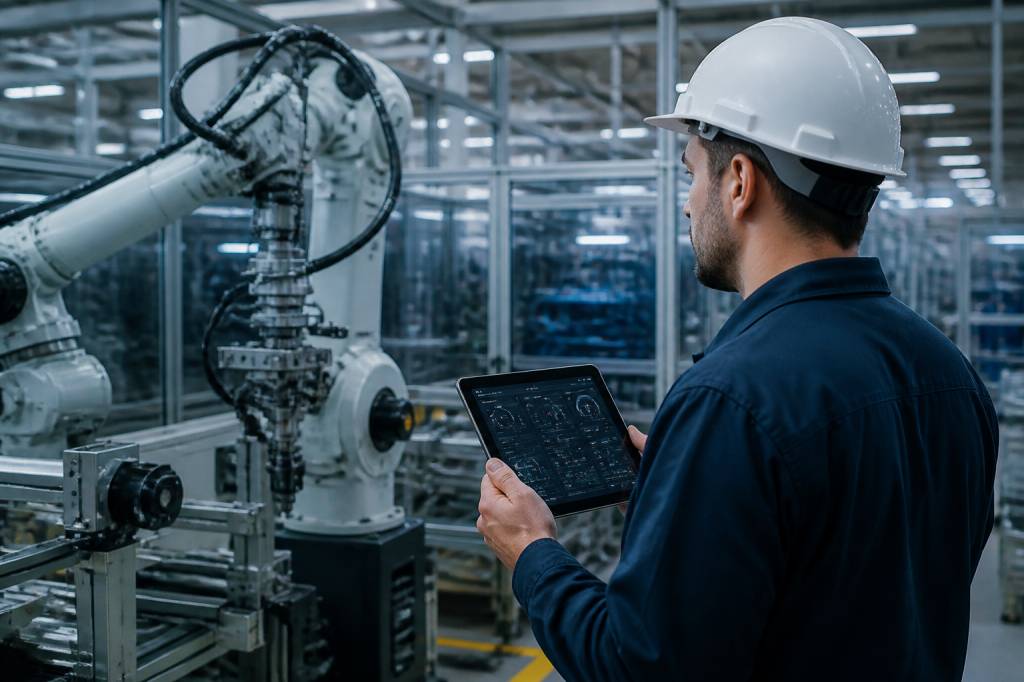
From automation to autonomy: what agentic AI changes on the shop floor
Manufacturing has spent decades pursuing the same promise: do more, faster, with less waste and fewer errors. First came mechanization, then industrial automation, then software-driven control systems, and more recently machine learning tools that help factories predict, detect, and optimize. Agentic AI is the next step in that evolution.
Unlike traditional AI systems that mainly classify, recommend, or forecast, agentic AI can take initiative. It can break down a goal into tasks, choose an action path, interact with software systems, and adjust its plan as conditions change. In practical terms, that means a system can monitor a production line, detect a quality deviation, identify likely causes, trigger a maintenance workflow, and coordinate with scheduling software to limit disruption. The machine does not just “see” the problem. It acts.
That shift matters because manufacturing is not a static environment. It is full of constraints: fluctuating demand, supply bottlenecks, energy price volatility, labor shortages, unplanned downtime, and stricter sustainability targets. In a sector where one missed shift can ripple through an entire supply chain, autonomy is not a futuristic luxury. It is becoming a competitive necessity.
What makes agentic AI different from conventional industrial AI?
Most industrial AI systems today are task-specific. A vision model checks weld quality. A forecasting tool predicts demand. A predictive maintenance model flags a motor likely to fail within 14 days. Useful? Absolutely. Autonomous? Not really.
Agentic AI goes further by combining perception, reasoning, planning, and execution. It can operate across systems rather than inside a single model. That means it may:
- interpret a production bottleneck from MES, ERP, and sensor data;
- prioritize possible interventions based on cost, lead time, and risk;
- execute a response, such as rescheduling a batch or alerting a technician;
- learn from the outcome and refine its future decisions.
The key distinction is not that agentic AI replaces human decision-making wholesale. It is that it closes the loop between insight and action. In many factories, the gap between “we know what the issue is” and “we did something about it” remains surprisingly wide. Agentic systems are designed to narrow that gap.
This is one reason the technology is attracting attention in sectors with complex workflows such as automotive, chemicals, industrial equipment, food processing, and electronics. These industries often rely on multiple layers of software and approvals that slow reaction time. Agentic AI can reduce that latency, provided it is deployed with strong guardrails.
Where autonomous systems are already delivering value
In manufacturing, the earliest value cases for agentic AI are emerging in areas where speed, variability, and coordination matter most. The technology is still maturing, but several use cases are already moving from pilots to operational deployments.
Predictive maintenance with automated response. Traditional predictive maintenance systems generate alerts. Agentic systems can go one step further by initiating maintenance workflows, checking parts availability, and suggesting the best intervention window. For a plant manager, that can mean avoiding an unnecessary shutdown while also preventing catastrophic failure. In sectors where unplanned downtime can cost thousands of dollars per minute, the economics are obvious.
Production scheduling under changing constraints. Imagine a plant running multiple product variants, with raw material delays, rush orders, and energy tariffs changing throughout the day. An agentic system can continuously evaluate those variables and propose a revised schedule, or even implement one within pre-approved limits. The value is not just efficiency. It is resilience.
Quality control and corrective action. Vision systems already detect defects. Agentic AI can connect defect patterns to process conditions and trigger adjustments upstream. If a batch begins to drift out of tolerance, the system may not just raise an alarm; it may recommend calibration, pause a line, or adjust process parameters before scrap accumulates.
Energy optimization. Industrial energy use is increasingly a strategic concern. Autonomous systems can shift loads, optimize HVAC and compressed air systems, and coordinate equipment operation to minimize peak consumption. For energy-intensive sites, that can translate into meaningful cost savings and lower emissions at the same time.
Supply chain orchestration. When a component delay threatens a line stoppage, agentic AI can search alternatives, evaluate supplier risk, estimate impact on delivery dates, and propose a reorder strategy. This is especially useful in plants operating with lean inventories, where a single missing part can cause disproportionate disruption.
Why manufacturers are paying attention now
Several forces are converging to make agentic AI more relevant in industry than it might have been just a few years ago.
First, the underlying data infrastructure has improved. More plants are instrumented with connected sensors, edge devices, MES platforms, and cloud-based analytics. Agentic systems need access to structured operational data, and more manufacturers finally have it.
Second, industrial software stacks are becoming more interoperable. APIs, workflow orchestration tools, and digital twins give autonomous systems a way to interact with real operations rather than remain in demo mode. In other words, the factory is becoming more machine-readable.
Third, the labor environment is tightening. Many manufacturers face skill shortages in maintenance, process engineering, and operations management. Autonomous systems do not eliminate the need for expertise, but they can support overstretched teams by handling repetitive coordination tasks and surfacing better recommendations.
Fourth, companies are under pressure to improve both productivity and sustainability. This is where agentic AI becomes particularly interesting. It can optimize throughput and energy use simultaneously, rather than treating them as separate objectives.
A recent McKinsey analysis on generative AI in operations estimated that advanced AI applications could unlock trillions of dollars in annual value across global industries. While not all of that value is specific to manufacturing, the point is clear: the productivity upside is significant. Agentic AI is likely to capture a growing share of that value because it targets the operational friction that often prevents factories from realizing gains already identified by analytics tools.
What changes on the factory floor?
The most visible change is not robots suddenly running the entire plant. It is the growing presence of systems that coordinate, recommend, and execute within defined boundaries.
For operators, that means less time spent reacting to alarms and more time supervising exceptions. For maintenance teams, it means fewer fire drills and more planned interventions. For production planners, it means less spreadsheet wrangling and more scenario management. For plant leaders, it means faster decisions backed by a system that can pull together operational data in real time.
But there is also a cultural shift. In many factories, decision-making has historically depended on tacit knowledge held by a small number of experienced employees. That knowledge is valuable, but it is also fragile. Agentic AI can help codify and scale some of those decisions, making operations less dependent on individual heroes and more resilient as teams change.
Of course, not every process should be automated to the same degree. A packaging line with stable conditions is a very different environment from a chemical process with high safety sensitivity. The right question is not “Can we make this autonomous?” but “Which decisions should be autonomous, and under what constraints?”
The business case: productivity, resilience, and margin protection
Manufacturing leaders usually want to know one thing first: where is the ROI? That is the right question, because autonomy without measurable impact is just expensive experimentation.
The business case for agentic AI typically rests on four pillars.
Reduced downtime. Even modest reductions in unplanned stoppages can create outsized value, especially in high-utilization plants. If autonomous systems can detect anomalies earlier and coordinate faster responses, the savings can be material.
Higher asset utilization. Better scheduling, fewer changeover delays, and smarter maintenance windows improve the amount of productive time per asset.
Lower waste and scrap. Autonomous quality interventions can stop deviations before they cascade through a batch or run.
Energy and labor efficiency. Agentic systems can optimize energy-intensive processes and reduce the administrative burden on teams that are already under pressure.
In practice, the strongest returns are likely to appear where operations are both complex and repeatable. Semiconductor fabs, automotive assembly, industrial chemicals, and high-volume discrete manufacturing are all plausible candidates. In each case, even small gains can have large financial effects because they scale across assets, shifts, and sites.
The risks are real: autonomy needs governance
It would be easy to oversell agentic AI as a self-improving production oracle. That would be a mistake. In industrial environments, autonomy comes with serious risks if it is not governed properly.
The first issue is safety. If an autonomous system takes an action that affects a physical process, the consequences can be immediate and costly. For that reason, many deployments will need human approval thresholds, hard constraints, and fail-safe modes. A system may be allowed to reschedule a line, but not to alter a safety-critical control parameter without operator sign-off.
The second issue is explainability. Plant leaders need to know why a system proposed a specific action. If an agent recommends shutting down a line to avoid quality risk, the reasoning must be traceable. Black-box autonomy does not fly in a production environment where accountability matters.
The third issue is cyber risk. The more systems can act, the more attractive they become to attackers. Autonomous systems that connect to operational technology, ERP, or supply chain tools must be designed with strong identity controls, segmentation, and monitoring.
The fourth issue is organizational trust. Workers are far more likely to accept AI if they understand its role. If autonomy is introduced as a replacement narrative, adoption will slow. If it is framed as decision support plus controlled execution, the path is smoother.
This is where leadership becomes critical. The companies likely to succeed are not the ones chasing the flashiest demo. They are the ones building governance models, accountability structures, and clear escalation rules before scaling autonomy across sites.
How to start: practical steps for manufacturers
For manufacturers exploring agentic AI, the smartest approach is to start small and operationally focused. Big-bang transformations tend to fail; targeted pilots with measurable KPIs have a much better chance of creating momentum.
- Identify one high-friction process where delays or errors are frequent.
- Map the data sources the system would need to act safely and effectively.
- Define the exact decisions the AI can make autonomously and the ones requiring approval.
- Set measurable success metrics such as downtime reduction, yield improvement, or energy savings.
- Test in a controlled environment before expanding to additional lines or plants.
- Involve operations, IT, OT, safety, and cybersecurity teams from day one.
One useful rule of thumb: if a process cannot be clearly measured, it is probably not ready for autonomy. Agentic AI performs best where inputs are visible, outcomes are trackable, and exceptions are manageable.
Manufacturers should also think about workforce design. The goal is not to remove humans from the loop. It is to move people toward higher-value tasks: interpreting edge cases, improving processes, and managing exceptions that machines cannot responsibly handle alone. That is not a loss of human relevance. It is a reallocation of attention.
What the next phase may look like
Over the next few years, agentic AI is likely to move from isolated use cases toward more integrated operational layers. We may see systems that coordinate maintenance, production, inventory, and energy decisions across an entire plant. We may also see more “supervised autonomy,” where AI executes routine actions within predefined policy limits while humans oversee strategic exceptions.
Digital twins will likely play a bigger role, allowing autonomous systems to simulate the impact of decisions before acting. Edge AI will matter too, because some factory decisions need to be made locally, with low latency and limited dependency on cloud connectivity. And as foundation models become more capable of reasoning across multiple data types, the boundary between analytics and operations will continue to blur.
None of this means the factory of the future runs itself without oversight. It means the industrial operating model becomes more adaptive, more responsive, and more data-driven. In a world where disruptions are frequent and margins are tight, that is not a minor upgrade. It is a structural advantage.
For manufacturers, the strategic question is becoming increasingly clear: when a system can not only detect a problem but also help solve it, how much value remains locked inside slow, manual workflows?