


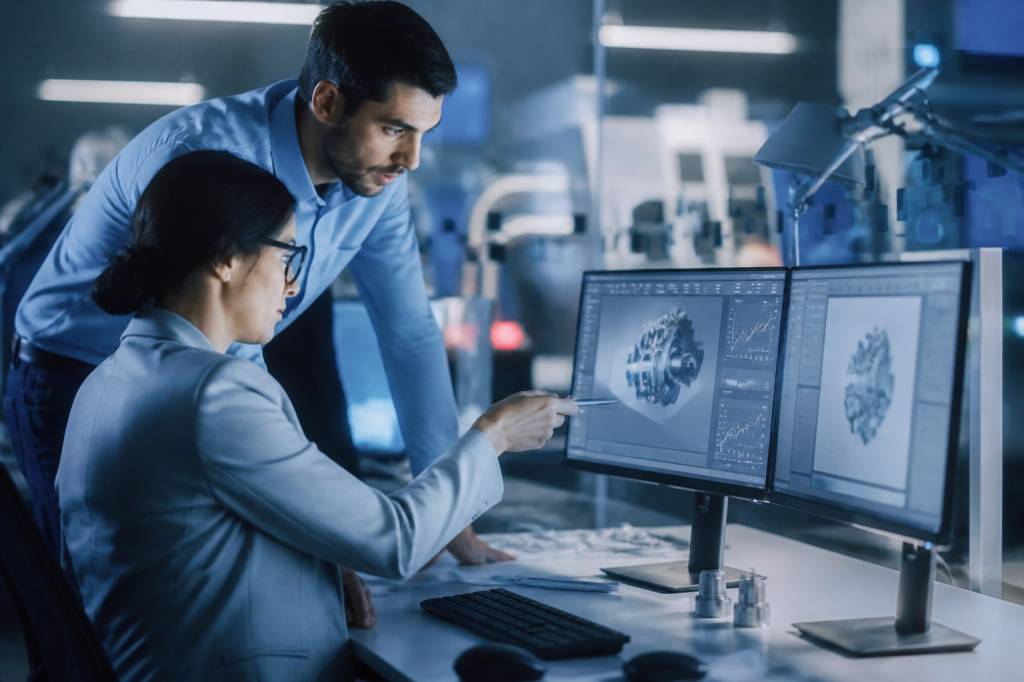
Industry is entering a new phase of digital transformation. The first wave connected machines and moved paperwork into the cloud. The next wave is more demanding: it must make factories, energy systems and supply chains more autonomous, resilient and sustainable while operating under tighter economic and regulatory constraints.
Information technology is no longer a support function sitting outside the production line. It has become part of the industrial core. Data platforms influence maintenance decisions, artificial intelligence helps optimise energy use, cybersecurity protects operational continuity, and advanced networks connect assets that were previously isolated.
The question for industrial leaders is no longer whether digital technologies will reshape their organisations. It is how quickly they can adopt them without creating new risks, excessive complexity or unmanageable costs.
From isolated systems to connected industrial ecosystems
For decades, industrial companies operated with a clear separation between information technology (IT) and operational technology (OT). IT managed business applications, employee devices and corporate data. OT controlled machines, production lines and critical infrastructure.
That division is steadily disappearing. Sensors, industrial internet of things devices, cloud platforms and advanced analytics are creating a continuous flow of information between the factory floor and executive decision-making. A production manager can now monitor asset performance in near real time, while a supply chain team can identify disruptions before they affect customers.
The benefits are substantial, but integration is not automatic. Legacy equipment often uses proprietary protocols, outdated software or systems that were never designed to communicate with external platforms. Connecting everything without a clear architecture can produce a digital version of the old industrial problem: more equipment, but not necessarily more productivity.
Successful companies are therefore focusing on interoperability. Application programming interfaces, industrial data standards and edge gateways help translate information between older machines and modern platforms. This approach allows organisations to modernise progressively rather than replace every asset at once.
The most effective digital programmes tend to begin with a specific operational challenge: reducing unplanned downtime, improving quality, cutting energy consumption or increasing worker safety. Technology is then selected to solve that problem, rather than introduced simply because it is fashionable.
Artificial intelligence moves from experimentation to operations
Artificial intelligence is one of the most visible forces shaping the future of industry. Its applications range from predictive maintenance and quality inspection to demand forecasting, process optimisation and intelligent energy management.
In predictive maintenance, machine-learning models analyse vibration, temperature, pressure and historical repair data. The objective is not to predict the future with perfect accuracy. It is to identify the probability of failure early enough for maintenance teams to act without interrupting production.
A wind turbine, for example, can generate thousands of data points every hour. Algorithms can detect patterns associated with gearbox wear or blade imbalance, helping operators schedule intervention during a period of low demand or favourable weather. In sectors where access is difficult, such as offshore energy, the economic value of avoiding an emergency repair can be considerable.
Computer vision is also changing manufacturing quality control. Cameras and AI models can identify surface defects, incorrect assemblies or variations that may be difficult for a human inspector to detect consistently across long shifts. The technology does not eliminate the need for skilled workers; it changes where their attention is most valuable.
Generative AI is adding another layer. Industrial employees can use natural-language interfaces to search technical documentation, summarise maintenance records or receive assistance while troubleshooting equipment. A technician should not need to browse hundreds of pages of manuals to find the correct torque specification. The challenge is ensuring that the system provides reliable, traceable information rather than confident but inaccurate answers.
For industrial AI to deliver measurable value, leaders must pay attention to five foundations:
- High-quality and properly labelled data
- Secure access to operational systems
- Human oversight for critical decisions
- Clear accountability when models produce errors
- Continuous monitoring as processes and equipment change
AI may be advancing rapidly, but industrial environments do not reward shortcuts. A model that performs well in a laboratory can fail when exposed to dust, temperature changes, unusual production batches or incomplete sensor data.
Edge computing brings intelligence closer to the machine
Cloud computing remains central to digital transformation, but industrial organisations are increasingly combining cloud platforms with edge computing. Edge devices process data near the source, whether that source is a robot, a substation, a refinery or a logistics hub.
This architecture offers three important advantages. First, it reduces latency. A safety system cannot always wait for data to travel to a remote cloud platform and return with a response. Second, it reduces bandwidth requirements by filtering or analysing data locally. Third, it can maintain critical functions when connectivity is disrupted.
Consider an automated production line operating in a location with limited network reliability. An edge system can continue to detect anomalies and control key processes even if its connection to the central cloud is temporarily unavailable. Once the connection is restored, relevant data can be synchronised for broader analysis.
Edge computing is particularly important for energy infrastructure. Distributed assets such as solar farms, battery storage systems and electric vehicle charging networks generate data across multiple locations. Local processing can help balance supply and demand, detect equipment faults and respond to fluctuations without relying entirely on a central data centre.
The result is not a competition between cloud and edge. The future industrial architecture will use both. Cloud platforms are well suited to large-scale analytics, fleet management and long-term data storage. Edge systems are better placed for real-time control and immediate operational decisions.
Private 5G and industrial connectivity
Connectivity is the nervous system of the digital factory. Wi-Fi remains useful, but industrial companies are also evaluating private 5G networks for applications that require reliable coverage, low latency and the ability to connect a large number of devices.
Private 5G can support autonomous mobile robots, connected tools, remote inspections and augmented-reality applications. In a large warehouse or manufacturing facility, it may reduce the limitations associated with fixed cabling and provide more consistent connectivity than conventional wireless networks.
One practical application is remote assistance. A field technician wearing augmented-reality glasses can share a live view of equipment with an expert located elsewhere. The expert can guide the intervention, display instructions or access relevant diagrams. This can reduce travel, shorten repair times and help address the shortage of experienced technical staff.
However, private 5G is not a universal solution. Its business case depends on facility size, existing infrastructure, application requirements and local spectrum regulations. Companies should first map their connectivity gaps and operational priorities. A new network is valuable only when it improves a measurable business outcome.
Digital twins connect engineering decisions with real-world performance
Digital twins are evolving from visual simulations into dynamic models that reflect the condition and behaviour of physical assets. A digital twin may represent a machine, a production line, a building, an aircraft engine or an entire energy system.
During the design phase, engineers can test different configurations before equipment is installed. During operations, the model can compare expected performance with actual data. This creates opportunities to optimise processes, anticipate failures and evaluate changes without disrupting production.
In the energy sector, a digital twin of a power plant can help operators understand how efficiency changes under different loads or weather conditions. In manufacturing, it can model how a new product will move through a production line before physical reconfiguration begins.
The quality of a digital twin depends on the quality of its data and assumptions. A visually impressive model that is not updated with operational information is little more than a sophisticated static diagram. The strongest implementations connect engineering data, sensor feeds, maintenance records and business objectives.
Digital twins also support sustainability strategies. Companies can model energy consumption, emissions and material flows, then test improvement measures before investing in new equipment. This makes sustainability less dependent on broad promises and more connected to operational evidence.
Cybersecurity becomes an operational priority
As industrial systems become more connected, the potential attack surface expands. A compromised office laptop is serious. An attack that disrupts a water treatment plant, manufacturing line or electricity network can have consequences far beyond the affected company.
Industrial cybersecurity must therefore protect both data and physical processes. Traditional IT security tools remain important, but OT environments require additional considerations. Some control systems operate continuously and cannot simply be taken offline for a software update. Some legacy devices have limited security features. In certain facilities, even identifying every connected asset can be difficult.
A resilient cybersecurity strategy typically includes:
- A complete and regularly updated inventory of IT and OT assets
- Segmentation between corporate, production and critical control networks
- Multi-factor authentication and strict access management
- Continuous monitoring for unusual behaviour
- Tested backup and recovery procedures
- Regular training for employees, contractors and suppliers
Supply chains require particular attention. Industrial companies depend on equipment manufacturers, software providers, maintenance contractors and cloud services. A vulnerability introduced by a third party can affect an entire production ecosystem.
Cybersecurity should therefore be treated as a condition for innovation, not an obstacle to it. The faster companies connect assets and deploy intelligent systems, the more important it becomes to build security into the architecture from the beginning.
Data centres, computing demand and the energy challenge
Advanced information technology requires substantial computing infrastructure. Artificial intelligence training, real-time analytics and industrial simulation all depend on data centres, networks and storage systems. This creates a strategic tension: digitalisation can improve efficiency while also increasing electricity demand.
Industrial leaders are beginning to examine the energy footprint of their digital operations more closely. Efficient cooling, workload optimisation, renewable electricity procurement and improved hardware utilisation can reduce the impact. Some data centres are also exploring heat recovery, using excess heat for district heating or nearby industrial processes.
The issue is particularly relevant as energy-intensive sectors electrify and digitalise at the same time. A factory may reduce gas consumption by adopting electric equipment, but its overall demand for electricity can rise because of automation, robotics and data processing. Technology strategies and energy strategies can no longer be planned separately.
Software efficiency matters as well. Not every data point needs to be transmitted or stored indefinitely. Edge processing, smarter sensor configuration and data-retention policies can reduce unnecessary computing loads without compromising operational insight.
Digital skills and the changing industrial workforce
Technology does not operate independently of people. The industrial workforce is changing as technicians, engineers and operators increasingly interact with data platforms, automated systems and AI-assisted tools.
This does not mean that practical expertise is becoming less important. In many cases, it is becoming more valuable. An algorithm can identify an unusual vibration pattern, but an experienced technician may understand whether the cause is a worn bearing, a change in product format or a calibration issue.
Companies need to develop hybrid skills that combine operational knowledge with digital literacy. Training programmes may include data interpretation, cybersecurity awareness, automation, cloud tools and responsible AI use. Partnerships with technical colleges and universities can help build longer-term talent pipelines.
There is also a management challenge. Employees may resist new systems if digitalisation is perceived as surveillance, a threat to jobs or another layer of administrative work. Leaders should explain how data will be used, involve frontline teams in system design and measure whether tools actually make work safer and more effective.
The most successful industrial transformations rarely come from technology alone. They come from technology combined with trust, practical training and a clear understanding of how work is performed.
What industrial leaders should prioritise now
The pace of innovation can make every new technology appear urgent. A disciplined roadmap helps companies distinguish strategic opportunities from expensive distractions.
- Define the operational problem before selecting the technology.
- Establish data ownership, quality standards and governance.
- Modernise connectivity and integration without abandoning valuable legacy assets.
- Build cybersecurity into every digital project.
- Start with pilot programmes that have measurable performance indicators.
- Scale solutions only after proving their economic and operational value.
- Invest in employees as actively as in platforms and equipment.
Useful indicators may include downtime reduction, production yield, energy intensity, maintenance cost, incident frequency, response time and employee adoption. These measures help executives assess whether a digital project is improving the business or simply adding another dashboard.
The future of industry will not be shaped by a single breakthrough. It will emerge from the combination of AI, connected assets, edge computing, advanced networks, digital twins, cybersecurity and human expertise.
For industrial organisations, the competitive advantage will belong to those that can turn information into reliable action. The factories and energy systems of the future will be more intelligent, but intelligence alone will not be enough. They will also need to be secure, explainable, energy-efficient and designed around the people who operate them.
That is the real direction of progress in information technology: not technology for its own sake, but better decisions made faster, with greater resilience and a clearer view of their economic and environmental impact.