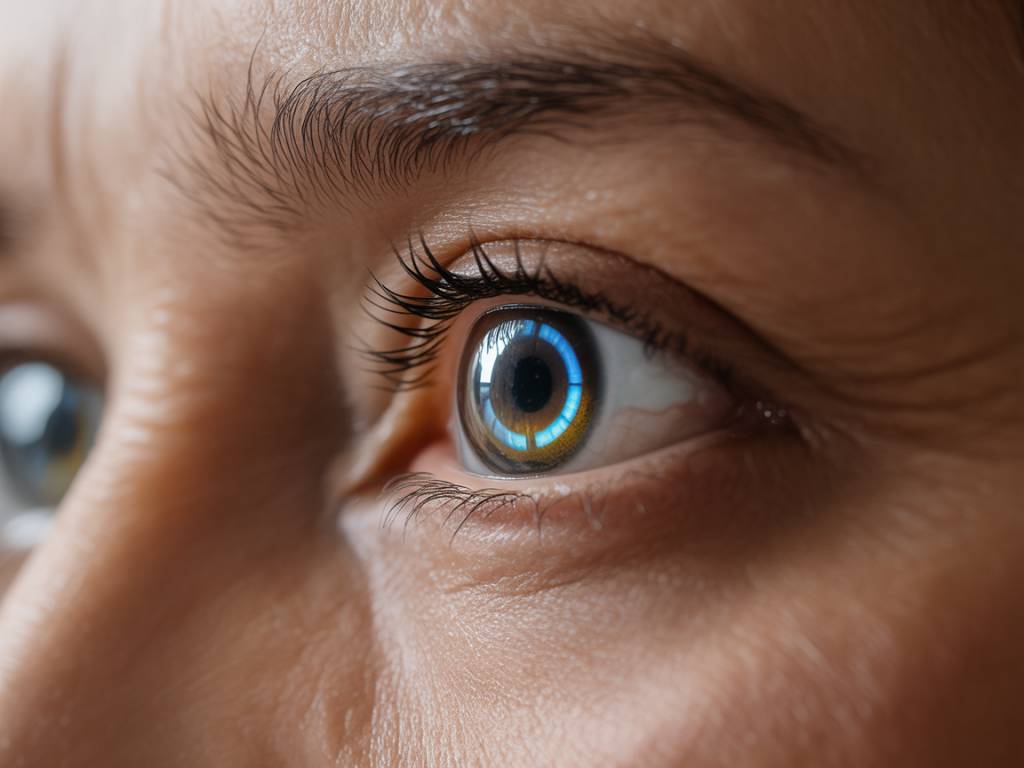
From glucose-sensing smart lenses to augmented reality displays embedded directly on the eye, “augmented contact lenses” are quickly moving from science fiction to early-stage prototypes. For the healthcare and industrial worlds, this is more than a gadget story. It is about shifting critical monitoring, guidance and data visualization from the wrist and the screen to the cornea itself.
What happens when your first “device” in the morning is not a smartphone, but what you put in your eyes?
From corrective optics to connected sensors
Contact lenses have long been a purely corrective tool: thin polymer discs designed to adjust refraction and little else. Over the past decade, two technological trends have changed that equation:
- Ultra‑low‑power microelectronics that can be embedded in flexible substrates.
- Biocompatible sensors capable of measuring biomarkers in tears or tracking eye parameters in real time.
Several R&D programs—and a handful of startups—are now exploring “augmented contact lenses” that go beyond vision correction to integrate three layers of functionality:
- Physiological monitoring: measuring glucose, intraocular pressure, temperature or biomarkers via tear fluid.
- Visual augmentation: heads‑up displays, task guidance, notifications or data overlays in the user’s field of view.
- Adaptive optics: lenses that dynamically change focus or tint based on lighting, fatigue or specific tasks.
In other words, the same surface that corrects vision could become a medical sensor, an industrial safety device and a productivity tool.
Why the eye is a strategic place for sensors
For medical monitoring and high‑risk work environments, continuous and non‑intrusive data collection is a long‑standing objective. Wearables—watches, patches, rings—have paved the way. Yet the eye offers several advantages that justify the intense interest around smart lenses.
- Access to tear fluid – Tears contain a variety of biomarkers, including glucose, electrolytes and proteins. They change more rapidly than some blood markers, opening the door to near real‑time monitoring.
- Stable wearing position – Unlike wristbands or glasses, a contact lens remains aligned with the eye and experiences less motion artifact. For imaging or precision tracking, that stability is key.
- High adoption base – Hundreds of millions of people already wear contact lenses. Extending a familiar object with additional functionality is usually easier than changing behavior.
li>Direct line of sight – Any display integrated in the lens occupies the most privileged “screen” in the human perceptual system. There is no need to look down at a phone or towards an external screen.
For industrial operators, this combination is particularly attractive. A lens that simultaneously corrects vision, monitors fatigue and provides visual alerts could consolidate three devices into one—while leaving both hands free.
Medical monitoring: beyond glucose
Smart lenses first gained public attention around 2014, when early projects explored tear‑based glucose monitoring for people with diabetes. While translating tear glucose into accurate blood glucose values proved more complex than anticipated, the broader medical potential of ocular sensors remains very much alive.
Current research areas include:
- Intraocular pressure (IOP) monitoring in glaucoma
Several prototypes use embedded strain gauges to detect subtle changes in corneal curvature corresponding to IOP fluctuations. Unlike a one‑off measurement in a clinic, a connected lens could capture 24‑hour pressure profiles, helping physicians adjust medication and better predict disease progression. - Early detection of corneal and ocular surface disease
By analyzing tear osmolarity, specific proteins or inflammatory markers, lenses could signal the onset of dry eye syndrome, infection or post‑surgery complications. For patients who have undergone refractive surgery or corneal transplantation, a “smart bandage lens” might become standard care. - Systemic disease monitoring
Researchers are investigating whether tear biomarkers can track conditions like kidney disease, neurodegenerative disorders or cardiovascular risk. If correlation proves reliable, a lens could provide a low‑friction way to monitor chronic pathologies between hospital visits. - Drug delivery
Some labs are integrating micro‑reservoirs or drug‑loaded nanoparticles directly into lens material. The idea: precisely dose ophthalmic drugs over hours rather than via eye drops that mostly drain away within minutes.
Across these use cases, the industrial implication is clear: part of the “lab” moves to the patient’s eye. This shifts value from episodic consultations to continuous data flows, from single‑use consumables to long‑term, connected medical devices.
From the factory floor to the operating room
Augmented lenses are not only a healthcare story. They also intersect with the broader trend of augmented reality (AR) in industry, where head‑mounted displays and smart glasses are increasingly used for training, remote assistance and quality control.
Why look beyond glasses, which already offer more room for batteries, processors and optics? For certain tasks, glasses remain the pragmatic choice. But lenses open up specific advantages in constrained or regulated environments:
- Compatibility with existing protective equipment
In oil & gas, chemicals or mining, workers already wear helmets, visors and safety goggles. Smart glasses add another layer, potentially causing discomfort or field‑of‑view obstruction. A smart lens can integrate within standard PPE without modification. - Hygiene and sterility
In operating rooms, pharmaceutical cleanrooms or semiconductor fabs, any external equipment is a contamination risk. A disposable sterile lens that provides checklists, vitals or process parameters directly in the surgeon’s or operator’s field of view could meet stringent cleanliness requirements more easily than bulky headsets. - Line‑of‑sight overlays
Because the display moves exactly with the eye, guidance or measurement overlays can be anchored to what the user is looking at. Imagine a maintenance technician seeing torque settings float next to each bolt they glance at, or a surgeon seeing an artery’s projected path superimposed on tissue. - Hands‑free, heads‑up workflows
Many industrial accidents still involve distraction or the need to look away from the task. Lenses can keep critical alerts—gas leaks, voltage hazards, proximity alarms—inside the worker’s visual focus without requiring any gesture or head movement.
In high‑value manufacturing (aerospace, medical devices, nuclear equipment), even a marginal reduction in errors or rework rates via better visual guidance can translate into substantial savings. The lens becomes another vector for operational excellence.
Key technological building blocks
Achieving all this within a 150‑micron‑thick, flexible, oxygen‑permeable device is a formidable engineering challenge. Several technology strands must mature and converge.
- Micro‑displays and optics
Some prototypes use micro‑LED displays only a few hundred micrometres wide, combined with waveguides or diffractive optics to project images onto the retina. The challenge is to ensure readability without obscuring normal vision, and to manage brightness in changing lighting conditions. - Power management
There is no room for a conventional battery. Options include:- Inductive power transfer from a discreet eyewear frame.
- Energy harvesting from eye movement or ambient light (micro‑PV cells).
- Ultra‑thin, flexible micro‑batteries with limited but sufficient capacity for intermittent operation.
The energy budget is extremely constrained, pushing designers towards event‑driven operation and aggressive duty cycling.
- Wireless connectivity
Low‑energy radio (e.g. Bluetooth Low Energy derivatives or proprietary sub‑GHz protocols) must fit within strict specific absorption rate (SAR) limits near highly sensitive ocular tissue. Many designs rely on a nearby relay—such as a frame or ear‑worn device—that handles high‑bandwidth communication, while the lens itself transmits only minimal data. - Materials and biocompatibility
Any electronics must be encapsulated to prevent corrosion and avoid contact with eye tissue, without compromising oxygen permeability. The interface between rigid chips and soft hydrogel materials is a particular pain point in reliability testing. - On‑board intelligence
Simple thresholding—“if glucose > X, send alert”—can be done locally. But for complex pattern detection or multimodal sensing, edge AI in a companion device (phone, watch, frame) will process data and feed back only the most relevant insights to the lens display.
For manufacturers in the optics, semiconductor and medical device supply chains, these needs open new markets: hybrid materials, stretchable substrates, micro‑assembly systems and specialized testing protocols for flexible, bio‑integrated electronics.
Data, privacy and ESG implications
A lens that “knows” your glucose level, your focus of attention and your time on task is also an extremely powerful data collection tool. From an ESG and regulatory standpoint, several questions emerge:
- Medical data governance
Continuous streams of physiological data are sensitive by design. Who owns that data: the patient, the hospital, the lens manufacturer or the platform operator? Clear consent mechanisms and interoperable, secure data standards will be prerequisites for hospital adoption. - Workplace monitoring and ethics
If lenses indicate fatigue or stress in real time, can employers use that information to intervene—positively (workload adjustment, safety pause) or negatively (discipline, evaluation)? Trade unions and regulators will likely scrutinize any deployment that touches cognitive or emotional metrics. - Environmental footprint
Disposable electronics raise sustainability questions. How will augmented lenses be collected and recycled? Can manufacturers minimize rare or hazardous materials while maintaining performance? As ESG metrics gain weight in procurement decisions, “design for disassembly” and material circularity could become competitive differentiators.
Companies positioning themselves in this emerging field will need robust answers not only in their technical documentation, but also in their governance frameworks and stakeholder engagement strategies.
Regulatory landscape: between class II and class III devices
Augmented lenses sit at the crossroads of ophthalmic products, wearables and medical devices. As such, they are inching their way through evolving regulatory categories.
In many jurisdictions, a purely corrective connected lens with no medical claim might be treated similarly to a smart wearable. But as soon as it monitors biomarkers, informs diagnosis or guides surgical procedures, it is likely to be classified as a higher‑risk medical device (class II or even class III in the US, Class IIb/III under the EU Medical Device Regulation).
Implications for industry stakeholders include:
- Extended development cycles – Clinical trials to prove safety, accuracy and effectiveness, particularly for diagnostic or treatment‑adjacent use cases.
- Quality systems at medical‑grade level – ISO 13485 compliance, post‑market surveillance, and formal risk management processes.
- Cybersecurity as a safety issue – For connected devices, regulators increasingly view cybersecurity as integral to patient safety. A compromised lens that misreports glucose or IOP values is not just a data breach—it is a clinical risk.
For industrial AR use cases without medical functionality, certification may instead fall under occupational safety, optical radiation and PPE directives. Even then, eye‑worn electronics will attract more scrutiny than a handheld device.
Adoption challenges: from comfort to trust
Even if technical and regulatory hurdles are overcome, adoption is not guaranteed. Two non‑technical factors will be decisive: user comfort and trust.
- Comfort and usability
Many people remain reluctant to wear contact lenses at all. For them, a “smart” lens will not lower the psychological barrier. Early deployments will likely target existing lens wearers and specific professional populations—surgeons, field technicians, pilots—where the benefits are obvious and training is already part of the job. - Reliability and fallback modes
For safety‑critical applications, users will demand clear behavior in case of failure. What happens if the lens loses power mid‑procedure? Are there built‑in cues to remove the lens if a sensor malfunctions? Redundant systems and clear human‑machine interface design will be as important as raw sensor performance. - Social acceptability
Unlike smart glasses, augmented lenses are invisible from the outside. That raises concerns about covert recording or data access. Transparent usage policies and perhaps even visible companion devices (frames indicating when the system is active) could help maintain trust in social and professional contexts.
Ultimately, successful products in this space will not be those with the most features packed into a lens, but those that integrate seamlessly into existing medical pathways and industrial workflows.
Opportunities across the value chain
For players in industry and energy, augmented lenses are unlikely to become a core product line. Yet they may still reshape parts of the value chain and influence strategic priorities.
- Energy & utilities operators – Field teams inspecting pipelines, transmission lines or offshore platforms could receive context‑aware overlays: corrosion risk zones, live SCADA data, safe approach distances. For complex interventions, remote experts could “see what the operator sees” via eye‑tracking data and provide guidance without travel.
- Industrial OEMs and integrators – Equipment documentation, maintenance plans and digital twins can be structured to feed directly into AR workflows, including lens‑based systems. Designing assets “AR‑ready” will soon be as standard as designing them “IoT‑ready.”
- Component suppliers – Precision optics manufacturers, micro‑LED foundries, flexible PCB providers and specialty polymer producers can position themselves as enablers of ophthalmic‑grade AR by adapting their processes to the stringent constraints of eye‑worn products.
- Healthcare providers and insurers – For chronic disease management, augmented lenses could become part of integrated care pathways that blend telemedicine, AI‑driven triage and personalized prevention. Insurers may view them as cost‑effective if they demonstrably reduce hospitalizations or complications.
These use cases may not reach mass scale immediately. But even in limited deployments—specific plants, surgical specialties, high‑risk teams—they can test new models of human‑machine collaboration and continuous monitoring.
Looking ahead: a quiet interface with big consequences
Unlike smartphones or VR headsets, augmented contact lenses do not announce themselves with glowing screens or bulky visors. They are, by design, almost invisible. That is precisely what makes them strategically interesting.
If they fulfill even part of their promise, they could shift how and where we interact with data in three ways:
- By turning the eye into a continuous medical sensor, providing clinicians with richer longitudinal data than any annual check‑up ever could.
- By embedding safety and guidance cues directly into workers’ perception, moving beyond “consulting instructions” to “seeing the right action at the right moment.”
- By redefining the boundary between the human body and digital infrastructure, in a way far more intimate—and regulated—than a smartwatch or phone.
For industrial leaders, the question is therefore not simply, “Will augmented lenses reach mass adoption?” but also, “What parts of our operations, data strategy and workforce management would change if they did?” The answers may well shape the next generation of medical devices, safety systems and human‑centric automation.